Empty Space Is a Feature: Six Japanese Design Moves That Stretch a 400-Square-Foot Rental

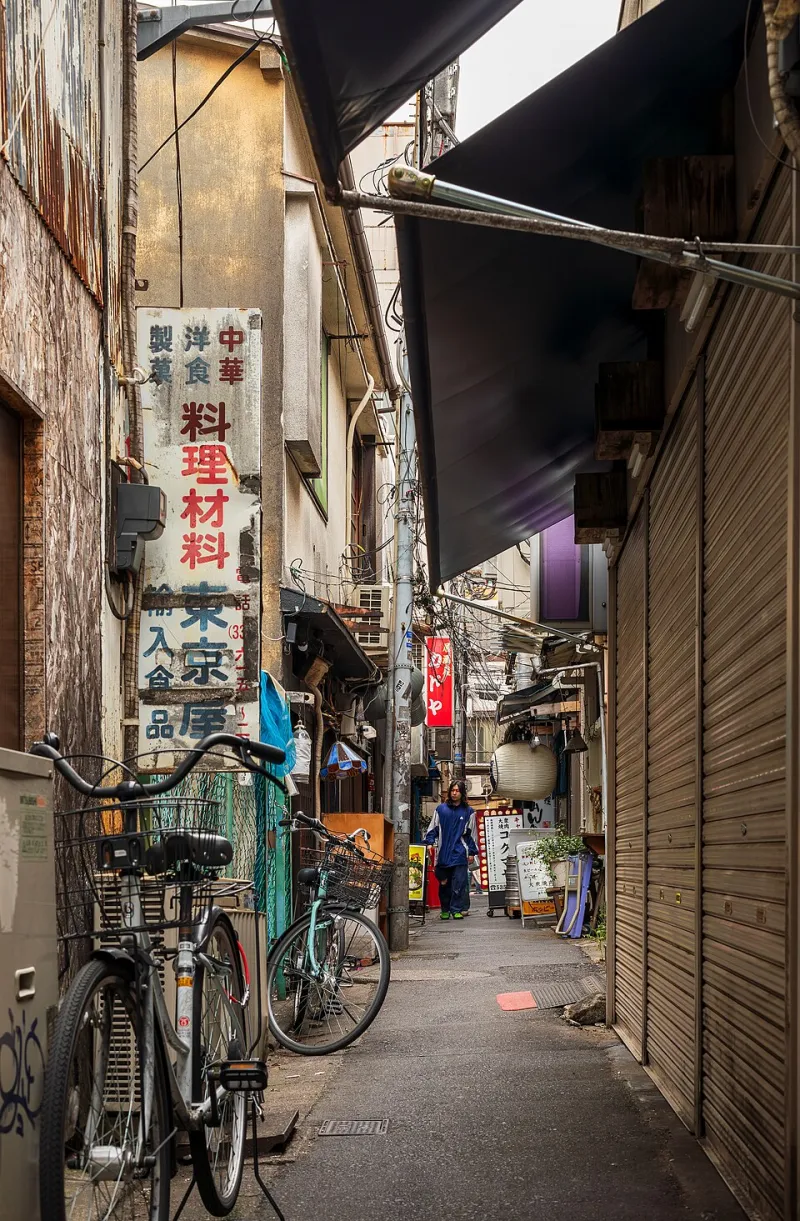
Photo: Pedro Ribeiro Simões from Lisboa, Portugal, CC BY 2.0, via Wikimedia Commons
Every small apartment I've ever visited in the US has the same instinct: fill the empty corner. The shelf goes there, then the plant on the shelf, then the basket under the shelf, and within a year the room has no empty corner and also no air. Japanese interiors tend to do the opposite. They treat the gap as the expensive part.
The idea is called ma — usually translated as negative space, though it's closer to 'the meaningful interval.' It's the pause in a sentence. It applies to rooms, to shelves, to the space between two objects on a wall.
Below are six rules I've watched work in a 380-square-foot Tokyo apartment and then tested, with permission, in friends' rentals in Portland and Philadelphia. None of them require a drill, a landlord conversation, or a trip to Japan.
The Tokyo apartment, before and after
Picture a one-room flat with a bed against the wall, a low table cluttered with mail, and a bookshelf pushed into the only walking path. Classic. The after version isn't a renovation — it's four moves: the bookshelf moves to the short wall and loses a third of its contents, the table clears completely, the bed gets a plain dark cover so it reads as one object instead of twelve, and one wall is left genuinely blank.
Same square footage. It photographs like it gained a hundred feet. Here's how each piece works.
Rule 1: Leave one wall completely bare
Not 'minimally decorated.' Bare. No gallery wall, no floating shelves, no TV.
Why it works: a blank plane gives the eye somewhere to rest, which reads as distance. Crowded walls make a room feel shorter because there's no visual exit.
Renter checklist:
- Pick the wall you never look at directly from the couch.
- Move everything off it — including the thing you're sure belongs there.
- Live with it for two weeks before you decide it feels empty. It won't by week two.
Rule 2: One focal point per room, not five
The tokonoma — the alcove in a traditional Japanese room built to hold exactly one scroll and one arrangement — is the most disciplined idea in interior design. One object, given full attention.
Why it works: your brain processes one strong thing faster than six medium things, and the faster it processes, the bigger the room feels.
Renter checklist:
- Choose your focal point: a window, one piece of art, or one lamp.
- Remove anything within three feet of it that competes.
- If two things are fighting for the same wall, one of them lives somewhere else now.
Rule 3: Put storage behind a door
The oshiire — the closet that swallows bedding, luggage, and everything seasonal — is why Japanese rooms look effortless. The mess isn't gone. It's just behind a panel.
Renter checklist:
- Anything you use fewer than twice a week goes in a closed container, not a beautiful open basket.
- Buy matching opaque boxes for the top shelf. Mismatched packaging is visual noise even at eye level you can't reach.
- A tension rod plus a curtain hides an open shelf for about $25 and zero wall damage.
Rule 4: Sit lower, and let one thing touch the floor
Low furniture drops the sightline, which makes ceilings feel taller. The Japanese floor-level table and cushion setup is not a lifestyle flex — it's geometry.
Renter checklist:
- Swap one tall piece for a low one. A coffee table at 14 inches instead of 20 changes the whole read of a room.
- Let exactly one large object sit directly on the floor — a plant, a floor lamp, a stack of books. Everything else gets legs or gets hung.
- Skip the floor cushion if your knees are American about it. A low sofa does the same job.
Rule 5: Let things show their age
Wabi-sabi is the least consumer-friendly idea in this list and the most useful. A worn wood surface, a repaired bowl, a linen cover with a crease in it — patina reads as calm. Glossy new everything reads as a showroom, and showrooms feel small because nothing in them has settled.
Renter checklist:
- Buy one thing secondhand that you'll keep for a decade. Thrift stores and estate sales beat the flat-pack aisle on this every time.
- Stop replacing scuffed furniture. Sand and oil a wood surface instead — $12 and an afternoon.
- Pick fabrics that get better with washing. Linen and cotton, not bonded leather.
Rule 6: Rotate with the season
Japanese rooms swap out textiles, art, and even small objects as the year turns. The practical effect is that the room looks new four times a year without buying anything.
Renter checklist:
- Keep a plastic bin of 'off-season' textiles — a heavy throw, a lighter one, a different set of pillow covers.
- Swap one piece of wall art on the first of each season.
- Clear the coffee table completely once a week. That's it. That's the whole ritual.
The budget version
You can do all six rules for under $150 if you mostly subtract. The things worth actually buying: opaque storage boxes, a tension rod and curtain, one low table or low lamp, and a single secondhand object with some history in it. Skip the aesthetic-minimalism starter kit — the beige ceramics, the diffuser, the $80 wicker basket. Those are purchases pretending to be a philosophy.
Start with the bare wall. It's free, it's reversible, and it's the one your landlord will never notice.